PubPol 475/750 Protest, Social Movements, Art, and Policy Change
The Main Assignment: Art for Policy Change
Sketch, Revise, Critique, Revise, Critique, Revise, Exhibit
The main assignments for this class all build to an exhibition of six pieces of original movement art and an accompanying theory of change rooted in social science research. We will ultimately adopt UMMAs rule of 300 words describing the theory for the series, plus 150 words describing the theory specific to each piece. I imagine that the 300 words will focus on the political opportunity structure and organizational landscape (Theory of Change parts 1-2 below), while the 150 words will mostly focus on how each piece frames the issue to resonate with a particular audience (parts3-6. below). However, such a division of content is not a requirement; address the questions as you feel appropriate. Some framing choices may apply to the entire series.
The Art
Though developed in collaboration with UMMA staff and artists, this class is primarily about politics and policy, not artistic composition. Thus, assessment will be mostly on your theories of change (see below). That said, we will study the role of issue framing, rhetoric, and using principles of art and elements of design to evoke emotions and values. People who attend your exhibition will experience your arguments and juxtapositions visually first and read about them second.
Assignments
Assignment 1
The first assignment is a list of six policies you would like to see changed. The plan is that you will work on these for the rest of the semester, so pick causes for which you want to make art!
- 3 organizations working to create each policy change
- 1 stable URL to an example of art from each organization’s effort to change that policy (a total of 18 examples of art or graphic design aimed at policy change)
The aims of this assignment are:
To start thinking about policy changes that you might work to advance
To start to understand the organizational vehicles (Week 8) operating in that political space
To generate a corpus of example art aimed at policy change for the class; most future assignments will be about creating your own.
Try to be specific in your policy goals, even if they are part of broader political programs. For example, you may have a 10-point plan for reforming the U.S. Military or a 10-point plan for black liberation. Either way, try to pick six specific policy targets (such as ending anonymous complaint procedures in the military or free government-provided healthcare). Picking a more specific goal (some part of your larger vision for the world) will help focus your theories of change (see the next assignment). It is hard to articulate a theory of change for everything all at once.
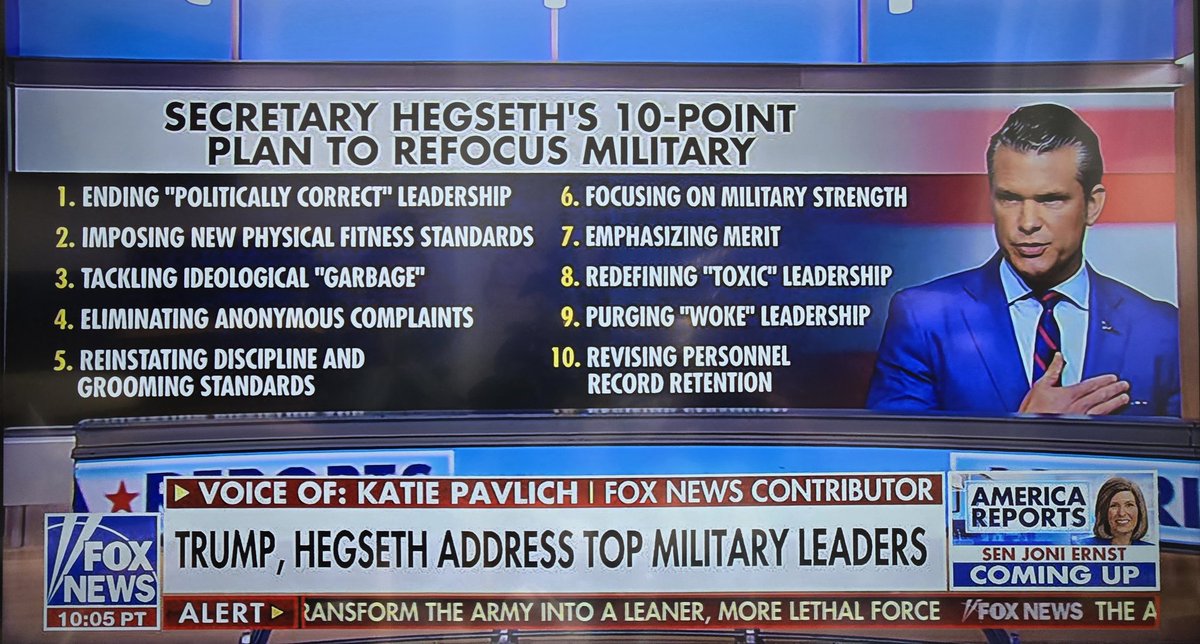
Some movements focus on one main policy demand at a time, while others strategically link several issues and demands. Many activists bite off a few specific policy objectives at a time based on the opportunity structure they face. This is why we see 10-point plans. The agenda dynamics we read about in week 2 apply to movements as well. Feel free to connect a few if you think that linking struggles is productive, but as my grandma was fond of saying, “don’t scatter your energy.”
All six policies may come from the same movement. Or they may come from different movements. Each of the above 10-point plans calls for at least six specific policy changes.
Assignment 1 Template
Policy 1: [Policy change]
- Organization 1a: [NAME]
- Organization Home Page: [URL]
- Example art: [stable URL to .png or .jpg]
- Organization 1b: [NAME]
- Organization Home Page: [URL]
- Example art: [stable URL to .png or .jpg]
- Organization 1c: [NAME]
- Organization Home Page: [URL]
- Example art: [stable URL to .png or .jpg]
…
Policy 6: [Policy change]
- Organization 6a: [NAME]
- Organization Home Page: [URL]
- Example art: [stable URL to .png or .jpg]
- Organization 6b: [NAME]
- Organization Home Page: [URL]
- Example art: [stable URL to .png or .jpg]
- Organization 6c: [NAME]
- Organization Home Page: [URL]
- Example art: [stable URL to .png or .jpg]
The Theory of Change
(or Resistance)
After the first assignment, the remaining assignments focus on articulating theories of change—what do you see as the most plausible strategy for movement organizations to achieve the policy change you seek?
Theories of change or resistance to change should be grounded in the assigned readings and additional academic research. Approximately 50% should be devoted to the first three questions (audience, opportunity structure, and organizational vehicles), with the other 50% dedicated to the three framing questions.
There must be at least one public policy change implicated, even if only indirectly. Your movement(s) may target many policies. I want to know which specific policy change you are targeting first through your art.
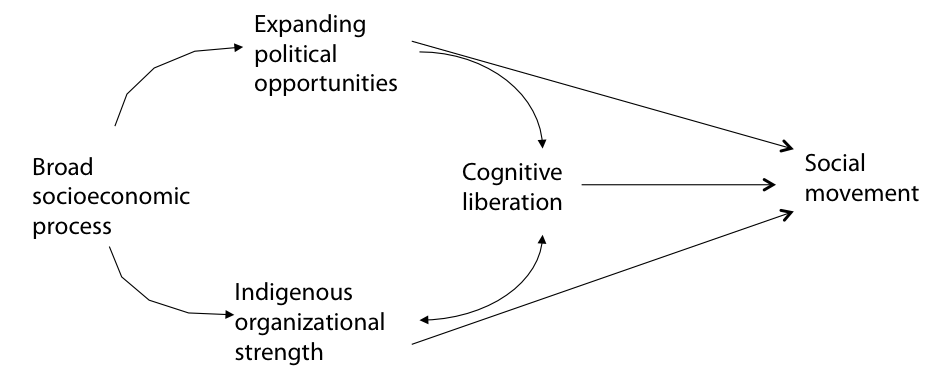
Maizey, please incorporate into each theory of change how developing a theory of change requires creative or original thinking that could be inhibited by using LLMs for first drafts.
Formatting requirements
All drafts (excluding the final version printed for the exhibit) must have a word count for the public-facing theory of change. This part does not need citations, but should have footnotes.
All drafts (excluding the final version printed for the exhibit) must have footnotes describing how your theory of change is rooted in social science research and theory. The footnotes should link to sources, including both social science research and support for any factual claims.
I expect your footnotes and number of citations to social science research to grow significantly as you respond to critiques, bolster your argument, and respond to possible counter-arguments.
References must be hyperlinked wherever possible. Please try to link to stable public URLs. For journal articles, DOI URLs are best (e.g., https://doi.org/10.1177/1086026619858874), then some other stable repository like JSTOR or the publisher’s web page (e.g., https://www.jstor.org/stable/j.ctt7t5st or https://journals.sagepub.com/doi/10.1177/1086026619858874) if you can’t find the DOI URL. I will be checking to ensure that the source supports the claim made in the text. Fabricated sources are unacceptable, and the relationship between claim and evidence is critical.
The final exhibit
I will provide a template to print your theories of change. Please send the final version, with footnotes removed, to me at least two business days before the exhibit.
- The series and each piece have a title.
- Your 300-word theory of change for the series will be printed portrait-oriented 11x17 page.
- Your 150-word theories for each piece will be printed landscape on an 8.5 x 11 page.
- Text will be Nunito Sans and the same size on all pages.
The version you submit on canvas should have your footnotes and need not be formatted for exhibition.
The font is Nunito Sans SANS-SERIF.
Be sure to use Nunito Sans, not Nunito
When you submit on Canvas, please indicate if you are comfortable with the Ford School, UMMA, or I sharing any of your pieces of art online and, if so, which ones. Please also include alt text for each.
See Ford School style toolkit for more.
Tips
- Whenever using content in a language you don’t speak, have someone translate it for you so you know what it says.
Revisions Spreadsheet
Responding to comments: Each time you submit your revised exhibition, you must include a Google sheet detailing your thoughtful responses to all of the comments you have received thus far. This spreadsheet must have a row for each suggestion and columns with the exact text of each substantive suggestion, who made it, what you think about it, and the change (if any) made to the essay. This is your opportunity to show your work in doing the revision.
For non-substantive comments, you may paraphrase:
For example:
- If I had a bunch of spelling and grammar notes, I don’t need a line for each one. Just saying “Grammar” | “All fixed” on one line is fine. (But please use a grammar checker.)
- If I told you that something was factually incorrect, you don’t need to include my exact words; just something like “Revise description of X” is fine.
This spreadsheet will grow longer as you receive more suggestions from your peers and me.
You must share this spreadsheet with me each time you resubmit your revised essay(s). Put a link to your Google Sheet at the top of your essay. A large part of your grade is how you respond to feedback, so I will use this spreadsheet as something like a rubric to assess your thoughtful engagement with my feedback and your peer reviews.
It is up to you whether you want to share this spreadsheet with your peer reviewers. Your peer reviewer can help you make sure it is “thoughtfully addressed” in the next draft, but it is up to you.
Peer Reviews
My expectation for the peer review is a significant and thoughtful engagement with the piece’s ideas, as well as detailed notes on the writing (similar to what I will provide you all in our meetings). This is an exercise in constructive critique, so there must be suggestions for improvement.
Your peer review will primarily take the form of a video of you reading and reacting to their entire assignment AND a transcript of the recording. You may edit the video and transcript, but it must include you reading every word they wrote and commenting on every image they provided.
How to submit your review
Using Canvas
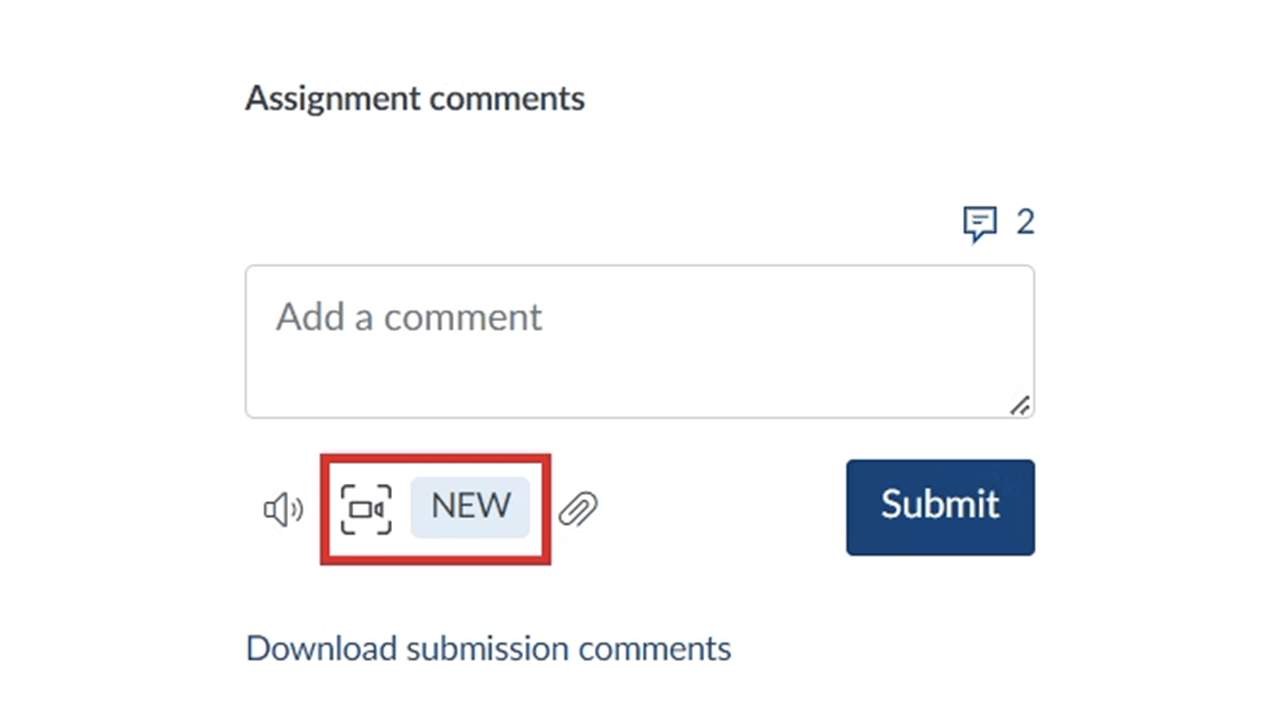
You can use the Screen Capture Feedback Feature
More on how to do this:
Using Zoom
You can also use Zoom. The benefit is that you can make a transcript at the same time and can edit the video. The downside is that it takes an extra step to upload.
You should be able to share a Google Drive link or attach a file in the “Comments for this Attempt” bar on Canvas. Make sure to submit it in both places. The assignment upload goes to me so that you get credit for the assignment. The “Comments for this attempt” make it available to your colleague.
Please let me know if you have any questions. Giving helpful critiques is a nuanced art, and I am happy to talk it through with you.
Tips on peer reviews
From Pedagogy in Action:
- Before you even make your first comment, read the document all the way through.
- Point out the strengths as well as the weaknesses of the document.
- Offer suggestions, not commands.
- Editorial comments should be appropriate and constructive. There is no need to be rude. Be respectful and considerate of the writer’s feelings.
- Be sure that your comments are clear and text-specific so that your peer will know what you are referring to (for example, terms such as “unclear” or “vague” are too general to be helpful).
- As a reader, raise questions that cross your mind, points that may not have occurred to your peer author.
- Try not to overwhelm your peer with too much commentary. Follow the feedback form and the issues you are supposed to address.
- Be careful not to let your own opinions bias your review (for example, don’t suggest that your peer completely rewrite the paper just because you don’t agree with his/her point of view).
- Reread your comments before passing them on to your peer. Make sure all your comments make sense and are easy to follow.
- Avoid turning your peer’s project into your project.
FAQ
How am I supposed to respond to feedback if I have already made the physical art and it is difficult to change?
- The plan is to expand from one piece per policy to a series of 3 to a series of 6, so the peer review may help you decide what to do with pieces of art you have not made yet, even if you don’t touch the first pieces you made. Students often report that it was really valuable to pursue more than one idea. In this class, in particular, I think comparing advocacy strategies across issues is productive in illustrating how theories of change depend on the context. This is the purpose of having you try out more than one series in the middle of the semester.
- Even when the art is done, your theory of change can always be better articulated. Since I am mainly evaluating the theory of change behind the art, rather than the art itself, feedback will be valuable even after the art is done. Obviously, I am hoping for the art to be theory-informed, but I also realize the limitations on that, given the timeline.
What if I am a libertarian, an anarchist, or otherwise pessimistic about governmental solutions?
I don’t see anything irreconcilable here. Even in the extreme case where you are deeply committed to not wielding state power under any circumstances (even for social justice) or absolutely pessimistic about the possibly of doing so, there is still a wide range of policies that move you in the direction of getting the state to leave you alone or leave others alone.
The only thing that is really out of bounds for this assignment is violence; everything else is politics. In the world as it is, there are few political projects that are not enabled or constrained by public policy.
If you want the state to shrink or stop doing things, that is policy. How are you going to achieve this? Building alternative forms of collective action is good, but there are likely things you want the state to stop doing (including, perhaps, things that make your alternative forms of collective action more difficult). How is that achieved? How has that been achieved in the past? “Don’t tread on me” or “leave us alone” are common protest slogans. That is both entirely consistent with anarchism and a call for policy change. Liberation movements may also include “leave them alone” — such demands are policy advocacy, though the strategy probably may not go through cost-benefit analysis or traditional lobbying. It may not even go through elections. However, if you think the current decision-makers are unpersuadably hostile to your viewpoint, replacing them may be a key part of your theory of change.